If you’ve ever opened a notice from the Horry County or Georgetown County Assessor’s Office and wondered what triggers a property assessment, you’re not alone. Five distinct events can cause your Myrtle Beach property’s assessed value—and your annual tax bill—to change, ranging from routine five-year reassessment cycles to home sales, renovations, and zoning changes. Understanding these triggers now can help Grand Strand homeowners avoid tax surprises and prepare a stronger case if an appeal becomes necessary.
At For What It’s Worth Appraisals, our certified appraisers have helped Horry and Georgetown County homeowners understand and challenge inaccurate property tax assessments for years. Whether your assessed value jumped after a county-wide reassessment, a recent home sale, or a renovation project, this guide breaks down exactly what triggers a property assessment and what South Carolina’s Act 388 means for your tax bill.
Below, we cover the five most common assessment triggers in the Myrtle Beach metro market, the difference between a county tax assessment and an independent real estate appraisal, and the steps to take if you believe your assessed value doesn’t reflect your property’s true market value. We’ll also explain the Assessable Transfer of Interest (ATI) rule, the 15% assessment cap, and how a professional appraisal strengthens your appeal.
Last Updated: July 24, 2026
Table of Contents
- Tax Assessment vs. Independent Appraisal
- The Top 5 Triggers for a Property Assessment Change
- County-Wide Reassessment Cycles
- A Real Estate Sale or Transfer (ATI)
- Physical Improvements to the Property
- Splitting or Subdividing a Parcel
- Changes in Legal Status or Zoning
- Understanding Act 388 and the 15% Assessment Cap
- What to Do If You Believe Your Assessment Is Inaccurate
- Frequently Asked Questions
- How FWIWA Can Help Protect Your Property Value
The Critical Distinction: Tax Assessment vs. Independent Appraisal
Before diving into the triggers, it helps to clarify a point of confusion for many Grand Strand property owners: the difference between a county tax assessment and a professional real estate appraisal. Both assign a monetary value to a property, but they serve entirely different purposes and rely on different methods.
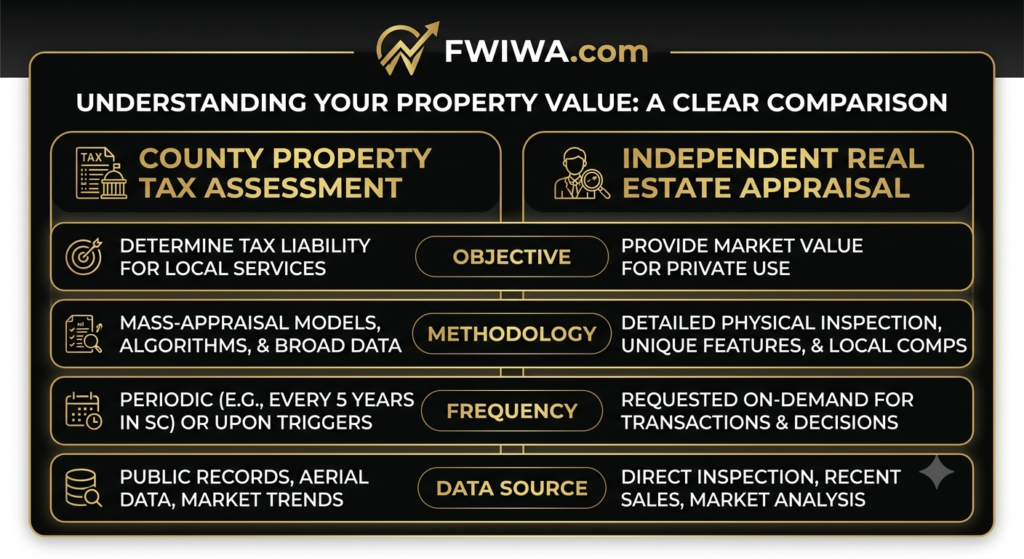
A county tax assessment is a mandatory, mass valuation conducted by the Horry or Georgetown County Assessor’s Office. It’s built from public land records, broad neighborhood data, and statistical models, and it’s used solely to calculate your property tax bill. Because it covers tens of thousands of parcels at once, it often lags behind real-time market conditions.
An independent real estate appraisal, like the home appraisals FWIWA provides, is a detailed, property-specific valuation based on a direct interior and exterior inspection and hyper-local comparable sales. It reflects current market value and is used for private purposes such as sales, refinancing, estate planning, and—critically—tax appeals. If you’ve never been through the process, our guide on what happens during a real estate appraisal walks through each step in detail.
- County Tax Assessment: Mass valuation, public records and trend data, updated on a fixed cycle, used to calculate tax revenue
- Independent Appraisal: Property-specific valuation, direct inspection and local comparables, current market value, used for private financial decisions and appeals
The Top 5 Triggers for a Property Assessment in the Myrtle Beach Metro Market
When we talk about an “assessment trigger,” we mean a specific event that prompts the county assessor to revisit and adjust your property’s valuation. Here are the five most common occurrences that will change your assessment in Horry and Georgetown Counties.
1. County-Wide Reassessment Cycles
Under South Carolina Code Section 12-43-217, every county must conduct a comprehensive, county-wide reassessment program at least once every five years. This cycle exists to keep the tax burden distributed fairly across all property owners based on current market realities, rather than outdated values from years earlier and misaligned with current sales activity, especially in fast-growing pockets of the Grand Strand.
If property values have grown significantly in the years since your county’s last reassessment—which has been the trend across many Myrtle Beach neighborhoods—you can expect your assessed value to rise during this systematic cycle, even if you haven’t made a single change to your home. Coastal and near-beach neighborhoods, along with newer master-planned communities in Carolina Forest and along the Highway 31 corridor, have generally seen some of the largest reassessment increases as demand has outpaced older, established areas further inland.
Horry County vs. Georgetown County: Are the Rules the Same?
Both Horry County and Georgetown County follow the same South Carolina statutes governing five-year reassessment cycles, ATI triggers, and the Act 388 cap. However, each county sets its own reassessment implementation year and mails its own Notice of Assessment on its own schedule. If you own property in both counties—which is common for Grand Strand investors with holdings that span the Waccamaw Neck and North Strand—it’s worth tracking each county’s cycle separately, since your Horry County assessment and your Georgetown County assessment won’t necessarily change in the same tax year. Our Myrtle Beach appraisers and Georgetown appraisers work across both counties and can walk you through the specific cycle that applies to your property.
2. A Real Estate Sale or Transfer (Assessable Transfer of Interest)
This is one of the most immediate and significant triggers in the entire system. Whenever real property is sold or a qualifying change of ownership occurs, South Carolina law classifies it as an Assessable Transfer of Interest, or ATI, under Section 12-37-3140.
Here’s the timeline: the ATI reappraisal date is set as December 31 of the year the transfer occurs, and that new fair market value takes effect starting with the following property tax year. In plain terms, if you buy a home in 2026, expect your assessment to reset to the purchase price for the 2027 tax year. If the property changed hands through a business entity rather than a direct deed, South Carolina law requires the new owner to notify the county assessor within 45 days of the transfer.
Once triggered, the assessor is legally required to reappraise the property to reflect its full current market value, effectively resetting the valuation to match the recent sale price. If a property has been owned by the same person for decades and sells today, the ATI trigger causes the tax assessment to jump substantially—often the biggest surprise new Grand Strand buyers encounter on their first tax bill.
Owner-Occupied vs. Investment Property After an ATI
How the ATI affects your bill depends partly on how you use the property. Owner-occupied primary residences in South Carolina are taxed at the state’s lower 4% assessment ratio, while second homes, rental properties, and investment properties are typically taxed at the 6% ratio. Buyers of non-owner-occupied property may also be eligible to apply with the county assessor for a partial exemption that reduces the impact of the ATI reset—but this exemption isn’t automatic. It must be applied for, and missing the application deadline generally means forfeiting it for that tax year, so it’s worth confirming the current deadline and eligibility rules with your county assessor’s office shortly after closing.
CALL OUR APPRAISERS: 843-808-1533
3. Physical Improvements to the Property
Have you pulled a building permit recently for a major renovation, an addition, or a new detached structure? The building permit process is directly linked to the county tax system, and completed improvements are a direct trigger for a localized reassessment.
The county will value the property “as improved.” Common examples include:
- Structural additions: Adding a bedroom, bathroom, sunroom, or expanding the living area
- Major features: Installing a swimming pool, garage, or large workshop
- Substantial remodeling: Renovation or reconstruction that changes the core functionality of the space
Routine maintenance and minor repairs—replacing a roof in kind, repainting, or fixing a fence—generally do not trigger a reassessment, since they restore rather than increase value.
In coastal Grand Strand communities, some of the most common permit-triggered improvements we see include screened-in porches and lanais, outdoor kitchens, elevated garages or storage areas on piling-built homes, and dock or boat lift installations on the Intracoastal Waterway. Because these projects typically require a building permit, the county will usually pick them up and adjust your assessment to reflect the added value once the work is finalized and inspected. Since so many of these additions change a home’s finished square footage, it’s worth understanding how Gross Living Area is measured in coastal markets like ours.
4. Splitting or Subdividing a Parcel
If you own a larger parcel and legally subdivide it into smaller lots for development or sale, this action triggers a mandatory reassessment. The original parcel ceases to exist in its old form, and each newly created lot receives its own tax map number and a fresh valuation based on its current market potential—not the blended value of the original tract.
5. Changes in Legal Status or Zoning
Any legal change affecting how a property can be used is a major trigger. For example, if a parcel’s zoning changes from agricultural to commercial, or from low-density residential to high-density multi-family, the property’s “highest and best use” has changed. The county will reassess the property to reflect the value inherent in its new zoning classification, which can significantly increase—or in some cases decrease—the assessed value.
Navigating the South Carolina System: Act 388 and the 15% Cap
To fully understand how property tax assessments affect you in Myrtle Beach, it helps to know one key piece of South Carolina legislation: Act 388.
This law provides an important protection for homeowners. During a county-wide reassessment cycle, Act 388 caps the increase in a property’s value: under Section 12-37-3140(B), the fair market value of an existing property cannot rise by more than 15% within a five-year period as part of a general reassessment. This shields long-term residents from being priced out of their homes by rapid market spikes.
The ATI Caveat: It’s critical to remember that the 15% cap is removed when an Assessable Transfer of Interest occurs. When a property sells, the new owner is taxed at full current market value, not the capped value the previous owner enjoyed. This is why many new buyers in the Grand Strand see a substantial jump in their property taxes compared to what the seller was paying. It’s also worth noting that additions and improvements are exempt from the 15% cap and are added to the assessment at their current market value, separate from the general reassessment.
What to Do If You Believe Your Assessment Is Inaccurate
The county’s mass valuation models are not infallible. They rely on algorithms and generalized neighborhood data, and they often miss crucial, property-specific details, such as:
- Recent cosmetic updates that didn’t require a permit
- Unseen maintenance issues, like an outdated HVAC system or aging roof
- Unique defects or location challenges affecting value
- Inaccurate public records regarding square footage or features
If you receive a Notice of Assessment that you believe doesn’t reflect your property’s true current market value, you have the right to appeal with the county board. This is a time-sensitive process—Horry County property owners typically have 90 days from the date printed on the notice to file a written objection with the Assessor’s Office, so it’s important to act quickly once a notice arrives. For a full breakdown of current deadlines by county, see our guide to assessment and appeal deadlines in South Carolina.
The Basic Appeal Steps
- Review your notice carefully: Confirm the deadline date and note the assessed value, property classification, and assessment ratio applied
- Gather evidence: Pull recent comparable sales, document any property-specific issues, and consider a professional appraisal to establish an objective current market value
- File your written objection: Submit your appeal in writing to the county assessor’s office before the deadline, stating your requested value and the basis for your position
- Attend the informal conference or hearing: The assessor’s office may schedule a conference to review your evidence before the matter proceeds further
- Escalate if necessary: If you can’t reach an agreement, you generally have the right to appeal further to the county Board of Assessment Appeals
An emotional argument that “taxes are too high” rarely moves the needle. A well-documented, evidence-based appeal—anchored by a certified appraisal—is what typically gets results.
Frequently Asked Questions
How often does my property get reassessed in South Carolina?
By law, Horry and Georgetown Counties must conduct a county-wide reassessment at least once every five years. Outside of that cycle, your assessment can still change if one of the individual triggers above occurs—such as a sale, a major renovation, or a zoning change.
Will my taxes automatically go up if I sell my home?
For the buyer, generally yes. The sale qualifies as an Assessable Transfer of Interest, which resets the property’s value to the current market price (typically the purchase price) for tax purposes, removing the 15% cap that may have limited the previous owner’s assessed value.
Does a new roof or HVAC system trigger a reassessment?
Typically no. Routine repairs and like-for-like replacements restore a property rather than add value or square footage, so they generally don’t prompt a reassessment the way a structural addition or major remodel would.
What’s the difference between my tax assessment and what my home would actually sell for?
Your tax assessment is a mass-appraisal estimate that can lag behind real-time market activity and miss property-specific details. An independent appraisal, based on a direct inspection and current comparable sales, is designed to reflect your property’s actual market value—which is why it’s the strongest evidence in a tax appeal.
How long do I have to appeal my property tax assessment?
In Horry County, you generally have 90 days from the date printed on your Notice of Assessment to file a written objection. Deadlines can vary by county and by whether you received a formal notice, so it’s best to confirm your specific deadline with the Assessor’s Office as soon as you receive a notice.
REQUEST A HOME APPRAISAL QUOTE
How FWIWA Can Help Protect Your Property Value
Successfully contesting a property tax assessment requires objective evidence—an emotional argument about taxes being too high won’t succeed before the tax board. The most powerful evidence you can present is a certified, professional, independent real estate appraisal.
At For What It’s Worth Appraisals, we’re your local experts in property valuation across the Myrtle Beach metro market, including Horry and Georgetown Counties. Our certified appraisers provide the precise, unbiased, USPAP-compliant appraisal reports you need to support your appeal. Unlike the county’s mass-valuation model, we inspect your specific property and select the most accurate, hyper-local comparables to determine its true worth.
Your home equity is one of your most valuable assets, and an accurate property tax assessment protects your cash flow. Whether you’re dealing with a scheduled reassessment, a recent purchase, or completed renovations, understanding these triggers empowers you to act with confidence.
Don’t guess about your property’s value or accept an automated assessment without confirmation. Contact FWIWA today to discuss how an independent appraisal can give you total clarity and ensure your property value is assessed accurately, fairly, and professionally.
Ready to protect your property value? Call 843-808-1533
For What It’s Worth Appraisals (FWIWA) provides USPAP-compliant residential appraisal services across Horry County, Georgetown County, and Brunswick County, serving homeowners, real estate investors, lenders, and attorneys throughout the Grand Strand.